Showing posts with label diy. Show all posts

2014-12-30

Recumbent: wheel brackets

Yesterday, I mounted the rear brake. Today I finished the rear wheel brackets. They're made from aluminium and are each others mirrir except from the (rear) derailleur mount.


Next step wil be mounting the rear wheel.

Keep on cycling!

2014-12-29

Recumbent: rear brake

It's quite a time ago, I updated this blog. Well, I've been busy with other things. Since spring I'm a board member of the Dutch Association for Human Powered Vehicles (NVHPV).

But during these holidays, I started working on my lowracer recumbent bike. As you may remember, the headset was mounted. Today I fitted the rear brake. I got both the Shimano Deore V-brake and a Tioga booster for free from Mossink!

First of all, I created the alumuniulm clamps. The edges aren't perfect but these won't be visible riding the bike.


Thereafter, I fitted the hinges and ...


... dry fitted the brake, booster and clamps combo.


The hinges didn't fit exactly to the booster. So I had to file which wasn't that difficult. Using epoxy and screws, I assembled the clamps to the frame, ...


  ... mounted the booster and ...


... attached the rear brake itself.


Along with the rear wheel, it starts looking a recumbent bike.


Next step will be to mount the rear wheel.

Keep on cycling!

2014-02-24

Recumbent: Headset


According to the plan, I created two little aluminium plates. I drilled some holes in them to attach the plates to the frame. Thereafter, I had to make a big opening to fit the front fork. This went terribly wrong. I drilled a circle of small holes of which I intended to make one big opening. The hole however, wasn't a circle. So I had to start again.

I created a new plate and drilled the holes again. Now I carefully removed the inner circle of the big opening and polished long enough to create a beautifull circle. Using some soap, I mounted the ring. Then I had to repeat the process to create the other half (one is mounted above and the other beneath the frame).


To find out if it all fits together, I assembled the frame along with the front fork and wheel. The project is in progress!


After finishing these metal parts, I milled the frame to the plates fit nice. Last but not least, I expoxied the plates to the frame and secured them with four screws each.

Next step will be mounting a rear brake.

Keep on cycling!


2014-01-16

Recumbent: joining frame & rear fork

Now the frame and the rear chain stays are ready, they can be joined together. At first, I thought I would use  dowels. (B.t.w. is that correct English? I mean wooden sticks to insert in both parts.) However, James stated in his design that just epoxy would do. So I glued them together and clamped them for 24 hours. Here's the result.


Please note there are two additional shelves at the outer sides of the rear stays to prevent clamping damage.

Keep on cyling!

2014-01-15

Recumbent: Rear fork

Now the (main) frame is ready, it's time to construct the rearfork. This part consists of two rear stays. Each of them will be constructed of two layers of birch plywood (5,5 mm - for strenght) plus one layer of whitewood (18 mm - the 'fill'). Again, the whitewood will be perforated to save weight.


These are epoxied together. Between the frame and the rear stays, two additional layers of whitewood (each 18 mm) are added to gain the correct inner width of the rear fork. As the bike lacks suspension, I'd like to be able to mount wide tires. Later on, I'll experience if this is necessary.


Next step will be attaching the rear fork to the (main) frame.

Keep on cycling!

2014-01-13

Recumbent: Frame

After choosing a design and selecting materials, I'm ready to start building the bike. The plans are excellent as they contain (technical) drawings, a shopping list, building instructions, some templates and pictures. First of all, I went shopping. I bought wood and aluminium.

I'll construct the frame of three layers of birch plywood (for the strenght) plus two layers of whitewood (the 'filling'). The'll be expoxied intermittent. First of all, I made a paper template.


Thereafter I cut the whitewood. To save weight I cut some holes so the frame will be - more ore less - hollow.


Next step was cuting the plywood and epoxying the layers together. I started to attach the mid three layers: whitewood (18 mm) - plywood (5,5 mm) - whitewood (again 18 mm).


Working with epoxy was new to me. However, everything went well. One has to wear gloves and a mask which is a bit uneasy. I worked carefully to prevent spoiling the glue on clothes, the work-bench, etc. Next step was attaching the outer (plywood) layers (each 3.0 mm) to the frame.


After the frame, I'll create a wooden rearfork.

Keep on cycling!

2014-01-07

Recumbent: Design

So I'm going to build a recumbent bike for randonneuring and light weight touring. But what is the best bike for these purposes? Well, opinions differ as I found out. Riding brevets, I saw different types of bikes. On the web, I nearly found any information about it. OK. But what seems logical?

First of all, I thought about a hight racer. I like their big wheels of at least 26". Visibility in traffic is also good. Their designs aren't that complex. Examples of these are found at Bacchetta, Rans and Volae. They seem easy to build. An option would be the Atomic Zombie High Racer.

Picture: Atomic Zombie
Please note that companies like Challenge, M5, Nazca and Optima also produce fast and good quality high racers. However, they lack the straight design from their competitior's bikes.

But let's be honest. I already own an Optima Orca with dual 26"wheels. The differences between my current recumbent and a high racer aren't that big.

Any alternatives? What about a long wheelbase bike like as these are often used in races like RAAM. No, I'm not going that far. ;-) Because of their long wheelbase they're comfortable. Manufacturers like Easy Racers and Rans build these. Recycled Recumbents offers plans for free. They can also be faired as Lonnie Morse showed. Nice in bad wheater!

Picture: Lonnie Morse
But... these are looong! Sharp turns are already difficult with the Orca. And we have many of them in the Netherlands.

Another successful bike in RAAM and Paris-Brest-Paris is the Lightning P38 (unfaired) and F40 (faired).  These proved to be fast and the faired one provides also wheater protection. Another bike in this category is the Zweirad und Zukunft Horizont. Maybe I could built a Atomic Zombie Spirit. OK, I've noticed the differences... I could make a fairing myself: there are many examples around the web.

Picture: Atomic Zombie
So I bought the DIY plan. These are nice and very clear. I started measuring and prototyping with a dummy frame, a seat and a fairing. Unfortunately, I wasn't able to find a good seating position wherein I could see the road in front of me and pedal comfortabley. This wasn't acceptable for me. So the search went on. No bike with a front fairing for now. Tips are welcome!

What about a Flevo Racer or a Python lowracer? Both have simple designs. I like the steering concept of the Python. As it's very low, it could be fast. It could also be made divideable.

Picture: Jürgen
But I hesistated about the front wheel drive. Besides the Python is too low for me: I want to be visible in traffic.

Would there be a compromise between 'high' and 'low'? A concept with rear wheel drive and above steering as I like it? What about a medium (not so low) racer? There are many of them, for example by Challenge and Optima. A feasible solution would be the Atomic Zombie Tomahawk. I choose the 2x4 Lowracer.

Picture: James Robinson
In fact, I like having two identical wheels. James offers these too. However, I choose this design as this bike is lower and different from the Orca.

Next time more about the choice of materials.

PS: When writing about 'simple designs' and the like, I don't mean this projorative. I only wanted to make clear that there are several types of design.

Keep on cycling!

Recumbent: Materials

Now I have a design, I can prepare the build of my recumbent bike. From what material should I fabricate the frame? Steel? Alumimium? Or carbon?

First of all, I considered steel as it has many advantages. It is strong, widely available and cheap. However, I can't weld. So, I went looking for a course or something like that. I found several schools educating professional welders but no one for amateurs c.q. within range c.q. nearby. So, if using steel, I had to find a firm to do the welding for me. This seemed not practical. So went looking for alternatives.

Maybe aluminium as it's light and stiff. But welding alumimium is even harder than joining steel. Maybe glueing. Seemed not strong and/or safe enough for me.

Then I had another idea. Carbon is easy to process. But how to make a strong and rideable frame? Well, I could use PVC pipes to form the frame and strenghten it with carbon. But would it be possible to construct such a form? Besides, carbon can become brittle. As this is the first bike I build, I hestitated to experiment with so many things concurrently.

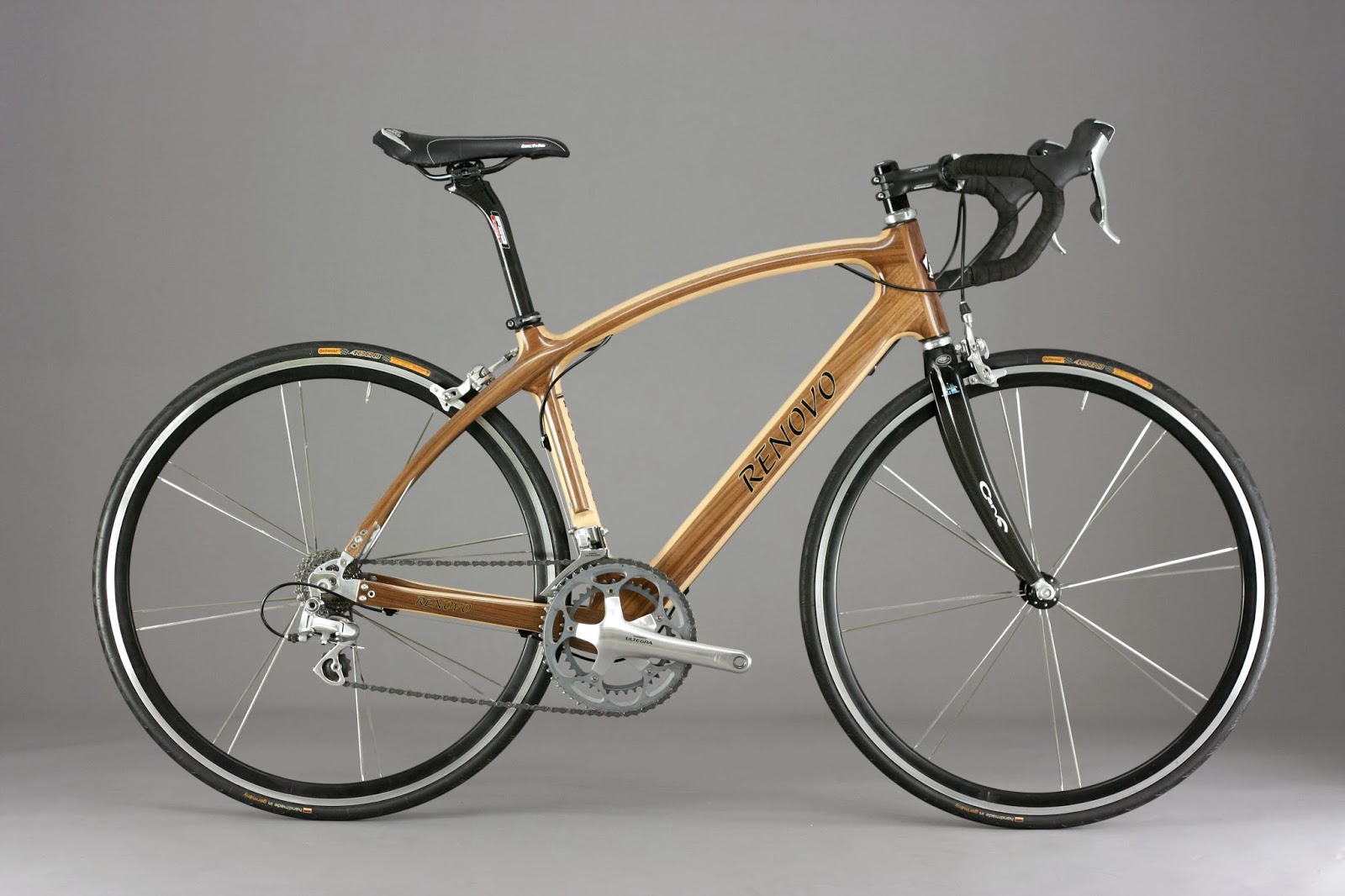
Then I read about wooden bicyles. Wood? Serious? I found out there are some commercial bikes available. AxalkoRenovo and Connor all produce quality wooden bikes.

Picture: Renovo Bikes
Altough I'm not an experienced woodworker, I can handle the material. At least, I think so. ;-) Furthermore, it's affordable. Besides some companies, several homebuilders have made nice wooden bicycles. To mention a few:


Last time, I told you I choose the 2x4 Lowracer. This recumbent is designed to be built from wood. Several people did so and two of them published their stories on the web: Ligneus and XnTrick. I contacted some of the people mentioned above. They - and others, like the designer, my dad and the team of Mossink - provided me with good advice. Very kind and helpful!

Meanwhile, I'm used to the idea the idea the recumbent will have a wooden frame. It's just as in the early days when the bikes were made of wood and the men of steel. ;-)

Now the design is chosen and the materials selected. Let's start the build.

Keep on cycling!

2014-01-03

I'm building a recumbent bike

Since I was a boy, I'm fascinated with recumbent bikes. When cycling to school, I sometimes met the guys of M5. They had their workshop nearby, just like Derk Thijs. As I told earlier, I now own a recumbent myself, an Optima Orca.

The Orca is a nice bike. I use it for touring and commuting. I even climbed Mt. Ventoux on it! It's very comfortable. As it's a high bike, I'm visible in traffic. But, there are many other good designs. Each with its own advantages and disadvantages.

On sites like ihpva.org, bhpc.org.uk and ligfiets.net I read about people self building bikes. It seemed cool! Not every design and/or build seemed good, practical or whatever. But I liked the people building amazing bikes with simple tools.

So I started researching the web and bought some books like Atomic Zombie's Bicycle Builder's BonanzaSo You Want To Build An HPVBicycle Design: The Search for the Perfect Machine and Bicycling Science.

In the meanwhile I rode several World Randonneur Brevets. Although I liked it, I thought of the ideal bike for it. Of course that doesn't exist. Every design is a comprise with its own strenghts and weaknesses. I decided to build a sportive bike for randonneuring and light weight touring.

In the posts to come, I'll tell about my experiende building my own recumbent bike. We'll start with choosing a design.

Keep on cycling!